

Diagnosed With PMOS, Now What? What Is Really Behind the Former PCOS
Rather listen? Jump to the episodeAn ultrasound, a quick glance at the screen, and then the sentence: “Your ovaries look like a string of pearls, that’s PMOS.” A few minutes later you are back on the street with a diagnosis, a prescription and more questions than before.
I know this moment from my own story. I was diagnosed with PMOS too, together with Hashimoto’s, and I was told I would never have a natural cycle.
I am Lina, a state-certified nutrition consultant, health coach for women’s health and an expert in cycle loss. In this article I explain what PMOS (formerly PCOS) actually is, how the diagnosis comes about and why very different stories can hide behind the same name.
What to expect
- 🏷️ From PCOS to PMOS: what the new name says
- 🩺 How the diagnosis is made
- 🌡️ Typical signs of PMOS
- 🔍 Same name, different causes
- ⚖️ PMOS or energy deficit?
- 🔄 Post-pill PMOS: when the diagnosis comes after stopping the pill
- 💊 Does only the pill help with PMOS?
- 🤰 Vroni: 17 years without a period, pregnant today
- 💛 My diagnosis and what I know today
🏷️ From PCOS to PMOS: what the new name says
You may still know the diagnosis as PCOS, polycystic ovary syndrome. The name was always a bit misleading: the “cysts” on the ultrasound are not real cysts but many small follicles that did not mature all the way to ovulation.
Since May 2026 the diagnosis has officially been called PMOS, polyendocrine metabolic ovarian syndrome. The new name is meant to make clearer what it is really about: not only the ovaries, but hormones and metabolism throughout the body. The diagnostic criteria stay the same, and the name is being adopted gradually over the next few years. That is more than cosmetics, because it shifts the focus away from the ultrasound image towards the question of what is going on in your system.
🩺 How the diagnosis is made
For the diagnosis, at least two of three criteria usually have to be met, and other causes should be ruled out first:
The three criteria
Irregular or missing cycles, meaning rare or absent ovulation.
Signs of too many male hormones, either in the blood or visible, for example as blemished skin or increased hair growth.
Conspicuous ovaries on ultrasound with many small follicles, in adults sometimes also assessed via an elevated AMH level.
The second part matters: before PMOS is confirmed, other causes should be ruled out, for example a thyroid disorder, raised prolactin or a missing period due to an energy deficit. More on that in a moment.
When it comes to the diagnosis, I always rely on the androgens, meaning male hormones such as testosterone. For me, raised androgens are a clear sign of PMOS, clearer than an ultrasound image alone.
🌡️ Typical signs of PMOS
PMOS shows up a little differently in every woman. Common signs are:
- an irregular, very long or completely missing cycle,
- blemished skin, increased body hair or hair loss on the head,
- strong blood sugar swings with cravings and energy dips,
- exhaustion and mood swings,
- difficulty getting pregnant.
Not every woman with PMOS has all of these signs, and not every one of these signs means PMOS. How a healthy cycle works in the first place is explained in this article.
🔍 Same name, different causes
Two women with PMOS can have completely different mechanisms behind it. For one, blood sugar is in the foreground: too much insulin stimulates the ovaries to produce more testosterone, and ovulation stalls.
For the other, it is more the nervous system under constant stress, or silent inflammation plays a role. The same name does not mean the same cause, and that is why the same tip doesn’t suit everyone.
PMOS is individual and depends on many factors: blood sugar, stress, sleep, thyroid, gut, inflammation, nutrition, movement and, not least, your story. In my 1:1 coaching I look at all of these factors together with my clients to find the path that suits them individually.
Free Hormone Signal Check
Find out within 5 minutes which of the 3 hormone traps you are currently stuck in.
⚖️ PMOS or energy deficit?
This point is especially close to my heart because it affects many of my clients. When your period stops after diets, lots of exercise, an eating disorder or great stress, this is called hypothalamic amenorrhea: your brain shuts the cycle down because it perceives scarcity and danger.
Here too, the ovaries can show many small follicles on ultrasound. The image looks similar, but something completely different is happening in the body. The hormone levels differ, and above all the two situations often need opposite steps.
Energy deficit + “fewer carbs, more exercise” even more scarcity the cycle stays away all the more
Especially if you have a history of eating disorders or train a lot, it is worth taking a second, careful look together with your gynecologist before you start eating even less or training even more.
🔄 Post-pill PMOS: when the diagnosis comes after stopping the pill
Many women get the PMOS diagnosis shortly after stopping the pill. Suddenly the period stays away, the skin goes haywire, and the ultrasound shows many small follicles.
This is often called post-pill PMOS. After years of synthetic hormones your body needs time to find its own rhythm again, and androgens can rise temporarily during this phase. It is not an official diagnostic term, but it is an important sign to look more closely before you resign yourself to a lifelong diagnosis.
💊 Does only the pill help with PMOS?
Let me be clear: the pill is not the solution for PMOS. It can mask symptoms such as blemished skin or heavy hair growth, but it doesn’t treat the cause, and it doesn’t give you back a cycle of your own.
The bleed on the pill is not a real cycle but a withdrawal bleed. It does not change what is actually going on in your body. At the latest when you stop the pill, for example because you want a child, the original question is often still exactly there, sometimes even louder than before.
Whether you take the pill for other reasons is something you decide together with your gynecologist. But don’t let anyone tell you it is the only answer to PMOS.
You are unsure whether your diagnosis is really PMOS or something else? In the free Cycle Clarity Call, we’ll look at your story together.
To the free Cycle Clarity Call🤰 Vroni: 17 years without a period, pregnant today
Vroni shows me how much is possible despite PMOS. She had no period for 17 years, plus digestive problems and a sluggish thyroid. For years she had defined herself through bodybuilding and planned-out meals, and she had been told she would simply have to live with her PMOS.
We didn’t give her a perfect meal plan or ban exercise. Instead, we went to where everything had its roots: to the part of her that had learned she is only good enough when she performs. And then came this message, after 17 years and despite PMOS: a period, with ovulation.
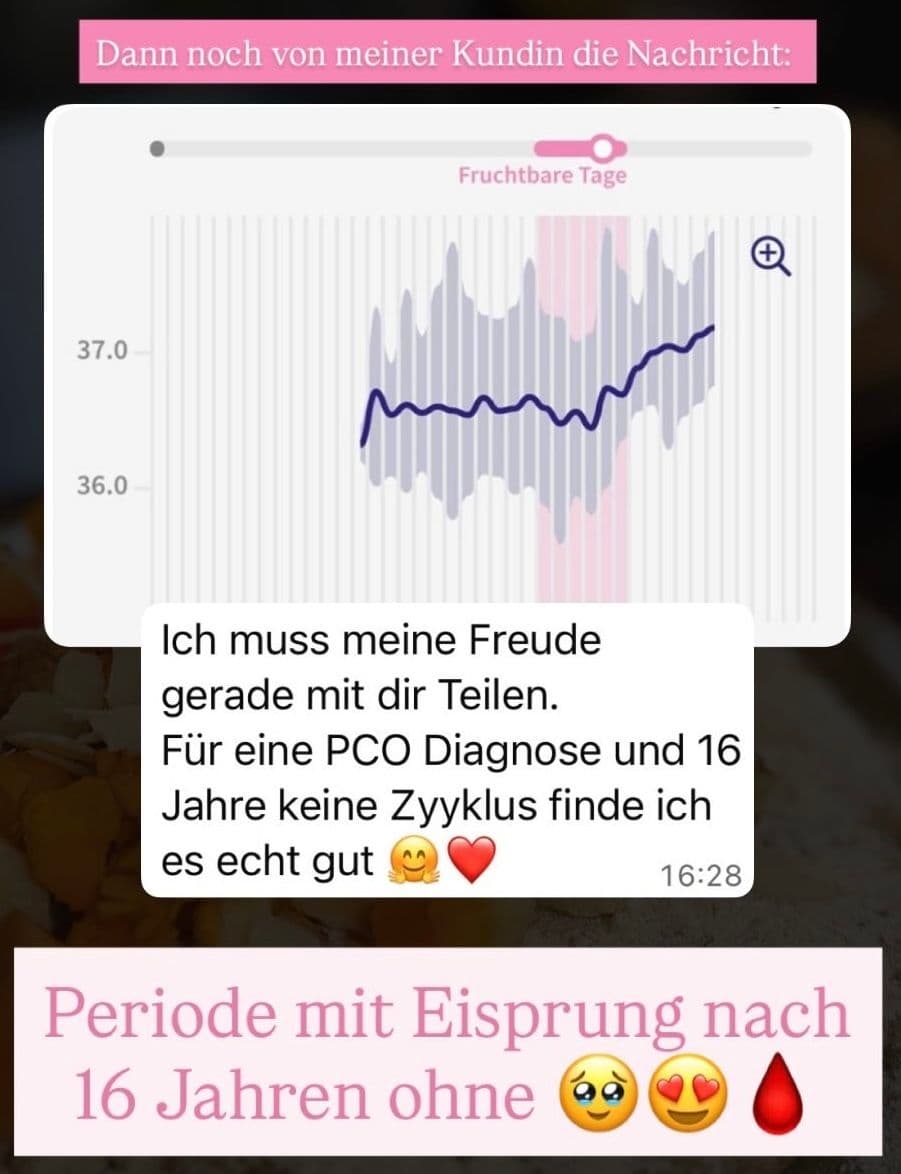
Today Vroni ovulates regularly. And in October 2026 the next message reached me: Vroni is pregnant, naturally. Three gynecologists had previously told her she was infertile.
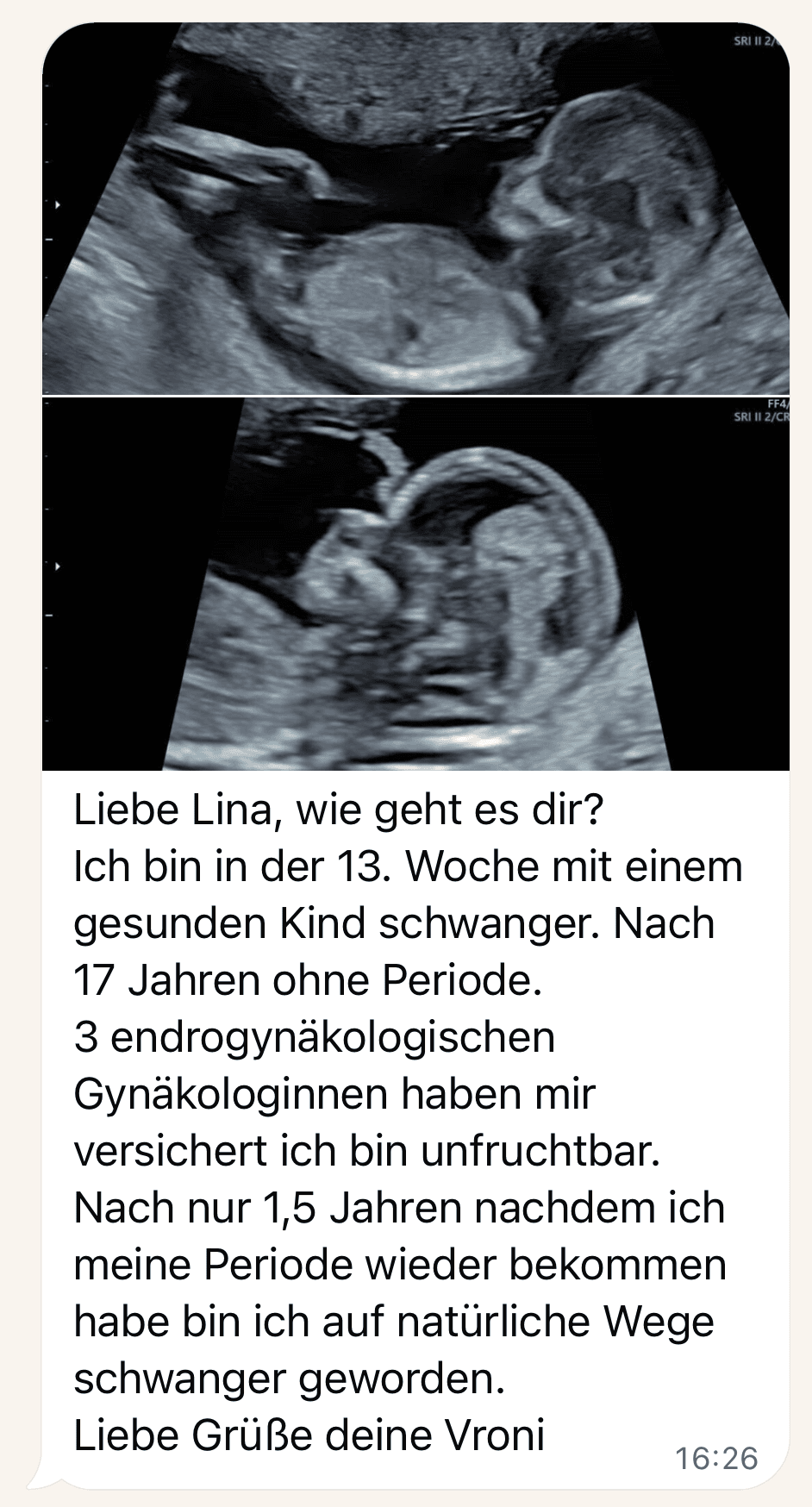
That is Vroni’s path and not a promise that every body reacts the same way. But it shows what can be possible when a body feels safe again. You can read her whole story in Vroni’s experience, and in episode 088 of my podcast she tells it herself.
🎧 Vroni tells her story herself: episode 088
💛 My diagnosis and what I know today
After my diagnosis I was told I would never get a cycle naturally, and for a while I was on hormone replacement therapy. Today, despite a PMOS and Hashimoto’s diagnosis, I have a wonderful cycle. That is my story and not a promise.
A diagnosis is a starting point, not a verdict.
What you can actually do if you have PMOS and want to get your period back is in my article with 5 tips for PMOS. And if you want to find out what is behind it for you, I’d love to look at your story together.
Would you like to talk with me about your challenges and goals and get your first impulses for your journey?
To the free Cycle Clarity CallSources & further reading
- Teede HJ et al. (2023): Recommendations from the 2023 International Evidence-based Guideline for the Assessment and Management of Polycystic Ovary Syndrome. J Clin Endocrinol Metab, 108(10), 2447–2469.
- Teede HJ et al. (2026): Polyendocrine metabolic ovarian syndrome, the new name for polycystic ovary syndrome: a multistep global consensus process. Lancet, 407(10545), 2329–2339.
- Gordon CM et al. (2017): Functional Hypothalamic Amenorrhea: An Endocrine Society Clinical Practice Guideline. J Clin Endocrinol Metab, 102(5), 1413–1439.
Happy, Healthy & Confident into the new week.
Every Monday — insights on cycle, hormones & female health. Straight to your inbox.