4 Years Without a Period: Emily’s Path to a Self-Confident Life
Rather listen? Jump to the episodeImportant first
This article talks openly about anorexia, exercise addiction, calorie counting and losing your period. This is Emily’s personal story, not a guide and not a promise that every path looks the same or takes the same time. Eating disorders are serious illnesses. If you are affected, please get medical and therapeutic support. I’m happy to support you alongside that.
It was really a prison I’d built around myself.
Toothpaste? Tracked. The tiniest piece of apple? Tracked. Nothing could be forgotten. Emily’s tracking app knew about every bite, sugar was off limits, and a day with fewer than 30,000 steps didn’t count as a successful day.
She last had her period in 2018. After that: four years of radio silence. And the crazy part: even when the scale had long shown a normal weight again, nothing happened.
Getting your period back after being underweight, even though your body is supposedly “normal again”? That is exactly what Emily did, about half a year after we started in 2021. Emily was one of my very first clients, back in my LT-Coaching days.
Today she is 30 and says: “For two years now I’ve really been centred again. I know who I am, what I can do and what my body needs.” How she got from that prison into a self-confident life, she’ll tell you herself today.
I’m Lina, a state-certified nutrition consultant and health coach for women’s health. I know this pattern not only from working with clients, but from my own story.
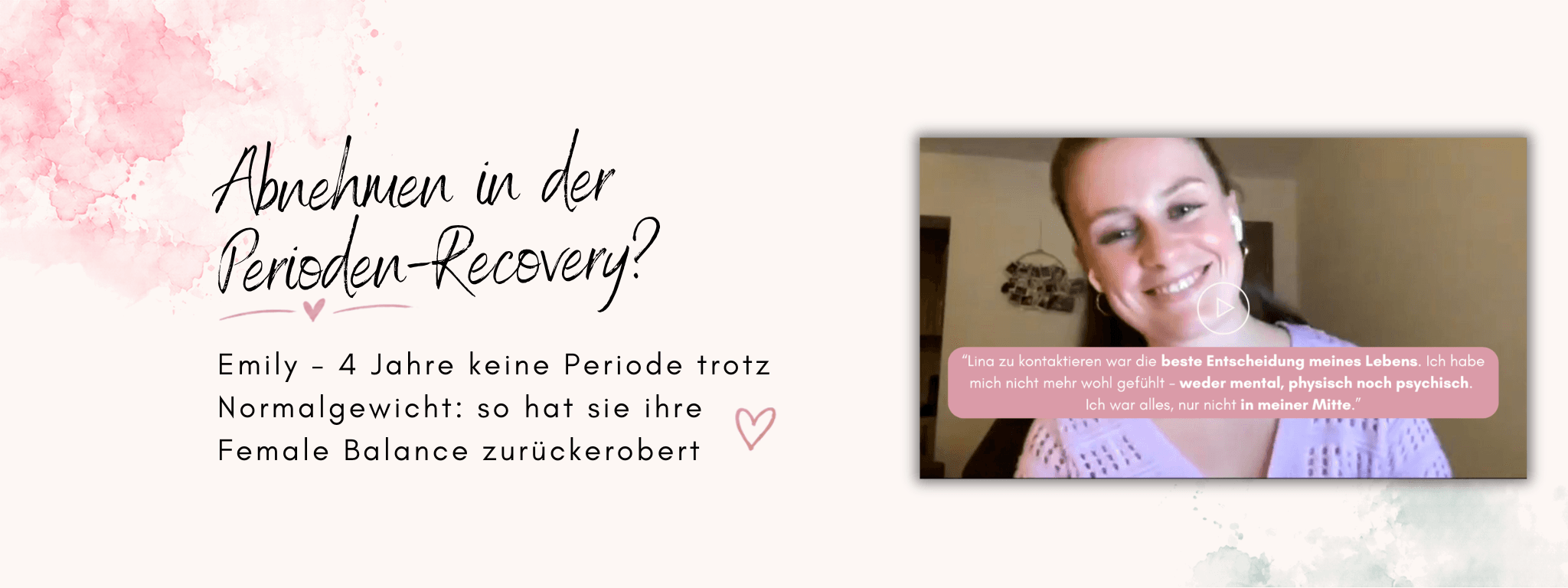
Emily in the short interview (in German)
Emily’s path at a glance
Around 22
The breakup
“I’m not worth being loved” – escaping into exercise and tracking
2018
Her last period
Then four years of radio silence
Rock bottom
The foot injury
From 30,000 steps to almost zero
2021
Starting with Lina
Plans for food and exercise, but above all work on her mindset
Half a year later
Her period is back
After four years without
Today
30 and centred
Eating intuitively, exercise for joy, “I am worth it”
What to expect
- When steps and calories run your day
- From 30,000 steps to almost zero
- She wanted to lose weight – I wanted her to eat more
- Getting your period back after being underweight: why it still took time
- From the plan to gut feeling
- It was never about the food
- Comparison, Instagram and real people
- What Emily does differently today
- Accepting help, even as a control freak
- Emily’s advice for you
- What Emily says about our work together
- Personal words to finish
When steps and calories run your day
At around 22, a hard breakup pulls the ground out from under Emily. What sticks is a sentence that digs in deep: “I’m not worth being loved.”
“And then you start escaping into something to make up for that pain,” she says. For her it was exercise, three to four hours a day. And if you train that much, you might as well “watch what you eat”, and suddenly the tracking was there.
This is how she describes her everyday life back then:
My whole life revolved around: how much am I eating, tracking calories, have I done enough exercise today, have I done my 20,000 steps. The whole merry-go-round of thoughts kept spinning all the time, and I wasn’t a happy person either.
Emily
Honestly, this is how it starts for many women. Not with the wish to be thin, but with a pain that has no other language right now. Running shoes and a tracking app then become a plaster you stick back on every morning. An eating disorder is never there without a reason.
From 30,000 steps to almost zero
After a few years Emily had reached her lowest weight, and then came the injury. She had been running excessively without the right shoes, and an inflammation in her foot suddenly left her barely able to move.
From 30,000 steps a day to what felt like 2,000 to 0. For someone with an eating disorder and exercise addiction, that is incredibly hard to accept.
Emily
Her body gained weight, and for someone who had been underweight for so long, that is the worst nightmare. Today Emily calls it “the complete package of: everything is awful”:
I can hardly walk, I can still exercise, but I feel totally uncomfortable in my body, I don’t know how to eat.
Emily
At some point during that time, Emily sits crying in front of the mirror and swears to herself: never again. Shortly after, she stumbles across me on Instagram, back then right in the middle of my bodybuilding days, and a few messages back and forth turn into coaching.
She wanted to lose weight – I wanted her to eat more
Emily’s goal back then was crystal clear: lose weight and, if it worked, maybe get her period back along the way. Especially in my early days, lots of women came to me with body goals exactly like that: lose weight, tone up, build muscle.
Yes, yes, yes, we looked at her goals. But deep down I always steered: eat more, eat in a more balanced way, get out of the numbers in your head and into intuitive eating. I had been through every extreme myself, from anorexia and binge eating to competitive bodybuilding, and knew pretty exactly what Emily was going through.
Back then I still worked with meal plans; today I work with guidelines. Emily’s first plan really shocked her: “No, that’s way too much, I’ll gain weight.” At the same time, that very plan was a relief for her.
It did me good not to have to think about what to buy anymore. Everything was set. Emily, you buy this, you eat this. That let me put down this intense food focus for a while.
Emily
It’s okay to eat more. It’s okay if you get your period back at some point. It’s also totally fine to treat yourself and have fun in life.
And then something happened that Emily would never have expected: she ate a lot more than before and lost weight at the same time. More energy, a better feeling in her body, and on top of that her period came back. “It all came together, it was wild.”
In between she doubted whether any of it was working, until I showed her a before-and-after picture and she could suddenly see the difference. Looking back, she says the work together was much more mental work than work on her body.
Free Hormone Signal Check
Find out within 5 minutes which of the 3 hormone traps you are currently stuck in.
Getting your period back after being underweight: why it still took time
When Emily came to me, the scale had shown a normal weight again for about half a year. Her period? Nowhere to be seen. And this is exactly the point where so many women despair: I’ve gained weight, what else does my body want?
Your cycle doesn’t look at the scale, it looks more at your bank account. One single pay cheque doesn’t make a cushion: only when enough energy comes in reliably over a longer time, there are breaks and the stress level drops, does your body dare to invest in something as costly as a cycle again.
That’s why: a normal weight is not the same as safety for your body. For Emily, a lot came together: eating enough, allowing breaks, letting go of control bit by bit. About half a year after we started, her period was back, after four years.
And one more thing mattered for Emily: we looked at her hormone levels and supported her through nutrition in a targeted way, for example her thyroid. It’s something like your inner engine and super important for a healthy cycle.
I felt really bad all day, I was in a bad mood, I was hungry and just didn’t know what was going on. And then my period came, and suddenly everything made sense.
Emily
Honestly, at first it was also a strange moment for her. “I don’t have my period, great, that means I’m underweight” – that’s how her head had calculated for years. And suddenly it was: “Now you’ve gained weight again, now your body is fertile again, now you’re normal again.”
In hindsight, it was the best thing that could have happened. Your body is always for you, never against you. It’s only trying to keep you alive, and we’ve forgotten how to listen to its signals.
From the plan to gut feeling
Many people think intuitive eating means: from Monday on, I’ll just eat by feel. Honestly, after years with a tracking app, that rarely works at the push of a button.
Even when you say, I’m eating intuitively now, you’re still doing the maths in your head all the time: have I eaten too much, too little, is there enough protein? It goes round and round in your head, and at some point you ask yourself: why am I even doing this?
Emily
So for Emily it went exactly the other way round: structure first, then trust. The plan gave her head a break, and in that break her body got to show that it doesn’t go off the rails with more food. When you trust a person, at some point you manage to trust yourself again too.
The transition was bumpy, it didn’t always work. But at some point I knew: okay, these are roughly the amounts I ate. Is it too much for me, too little? And at some point it became so automatic that I didn’t really deal with the tracking anymore.
Emily
Looking back today, she’s amazed herself: she used to eat huge amounts of food with as few calories as possible. Today she goes out to eat with friends and cooks without racking her brain over whether she’s allowed this.
How often do you still do the maths in your head, even though you officially don’t track anymore?
It was never about the food
If I had to put Emily’s story into one single sentence, I’d take hers:
It was never the food, it was never the exercise. It was me.
Her whole self-image was shaped by “I’m not worth being loved”. When she looks at photos from back then today, she thinks: “You actually had a completely normal figure. I’d love to rescue the Emily of back then and tell her it’s all okay, focus on your mental health.”
And why is it so hard to let go? Imagine a little Harald with a notepad sitting in your head. He writes down everything you’ve ever heard, seen and felt, and he’s constantly looking for proof of what he already believes: “I’m not good enough.” If you binge or the scale shows a kilo more, he shouts triumphantly: “See, I told you so!”
Your head is above all afraid of what it doesn’t know yet. If the eating disorder is all you know, it’s your familiar safety. You’re not in control when you track, but when you learn to listen to your body.
Something else struck me in my conversation with Emily: we almost always introduce ourselves with a label. I’m Lina, nutrition consultant, blah blah blah. I’m a mum, I’m an athlete, I’m something. Emily tried it right away: “I’m Emily. Hi.”
When did you last simply say: I am. Full stop. No label, no achievement behind it?
You recognize yourself in Emily’s story and don’t want to go through this alone any longer? In the free Cycle Clarity Call, we’ll look at where you are right now, together.
To the free Cycle Clarity CallComparison, Instagram and real people
Of all things, Instagram led Emily to me. And at the same time, Instagram was also part of the problem.
All you saw were thin girls, toned, and then you look at yourself …
Emily
Comparison is a huge topic in recovery, and your feed is about as realistic as a catalogue photo. My tip is so simple it almost sounds ridiculous:
Your first step
Go to the outdoor pool or sit in a café and watch people for a while. Then you’ll see real bodies, with bellies, with dimples, with life.
By the way, Emily has developed a pretty fine radar today: she quickly notices when someone around her is struggling with food or exercise, because she knows the signs from herself.
What Emily does differently today
I asked Emily what she is proudest of today. Her list:
Her self-perception has turned around completely, from “I’m not worth being loved” to “I am worth it”.
Eating enough for her body to function: when she runs out of energy, today her first question is whether she should eat something.
She eats intuitively. The transition from the plans was bumpy, but at some point it happened all by itself.
Going out to eat with friends and cooking without racking her brain.
Cycling more than 100 kilometres for the first time, with a friend and full of energy.
Exercise for joy, in lots of different sports, without chasing a body ideal.
Accepting help and sometimes handing over responsibility, even though, as she says, she’s a bit of a control freak.
I no longer have this need to chase some body ideal, to have an extreme bodybuilding figure or be super slim, I just want to feel good. I have energy and can do the sport I feel like doing.
A few years ago I woke up thinking: oh God, how am I going to get through this day, I can’t exercise, I can’t eat anything because then I’ll get fat. I simply don’t have these thoughts anymore, and it’s so freeing.
Emily
That’s why she celebrated her 30th birthday very consciously: “I knew, okay, I can leave this whole time behind me. It was a wild time, but I made it.”
Accepting help, even as a control freak
Are you one of those women who’d rather keep everything in their own hands?
Then this part of Emily’s story will probably pinch a little.
I’m a bit of a control freak too and like to keep everything in my own hands. Trusting people who have experience with it is really hard for me. But that was one of the most important points: accepting help, embracing it and then seeing what I can make of it.
Emily
And then there’s that nasty thought I hear in so many conversations: “It’s not that bad for me yet. Others need help more urgently.” Emily was never in hospital, and for a long time it was simply uncomfortable for her to admit she had a problem.
Back then there was this whole thing: if you go to therapy, something’s wrong with you. Oh, how embarrassing, she’s getting help. And that’s the biggest nonsense ever, because it’s absolutely fine to get help. It’s even important.
Emily
Honestly, I know this too, and not only when it comes to food. When I founded my company anew, it was incredibly hard for me to get help. Today I’m so grateful that I’m allowed to hand over responsibility sometimes.
A pattern Emily still knows today: people pleasing. The calendar is full to the brim, and at some point she pulls the emergency brake: “Stop, what do I actually want? What do I need right now to be happy again?” Then she also cancels appointments, even when it’s hard.
Emily’s advice for you
I asked Emily what she would say to a woman who believes the train has long left for her. Instead of “You can do it!”, she said something much more honest:
I think you have to take each day on its own and try to work on yourself a little bit. You don’t have to take huge steps, but set yourself small milestones. If you only ever work towards the big goal, you don’t see the amazing things that are already happening in between.
Emily
She also openly admits that she’s super impatient: “At certain points I thought, this isn’t doing anything anyway. In between, I didn’t see it.”
In the end everything will be okay, and if it’s not okay yet, it’s not the end yet.
What is the smallest possible step you can take today?
What Emily says about our work together
Contacting Lina was the best decision of my life. I didn’t feel good anymore – not mentally, not physically, not psychologically. I was anything but centred.
I would definitely recommend Lina, because she doesn’t just focus on small areas of life, but looks at the person she’s supporting as a whole and looks into every area. She goes deep into whatever issues are there, because a person has to be seen as a whole being.
It’s not always just one thing that makes you slip into an eating disorder or exercise addiction, it’s lots of factors. And I think Lina is the perfect person to recognise that.
When you have someone at your side who has been through all of it, they simply have the knowledge and the know-how: hey, I can help you, it gets better, we’ll get through all of this together.
Of course you have to walk your path yourself. But it’s always easier when you have someone at your side who gives you the right tools and doesn’t make you feel you’re wrong, but rather: no, you’re exactly right, and the path you’re on, we’ll walk it together.
Emily
Personal words to finish
Dear Emily, before our conversation I scrolled through our old WhatsApp chat again and had to smile so often, because it feels like yesterday. And afterwards, as so often, I sat there with tears in my eyes.
Thank you for your courage to share your story, and for your trust, back then and today. And thank you for giving Emily space. And as I so often say: fear is your best friend. It shows you that you’re daring something new.
Having supported more than 250 women, I see it again and again: the path is different for everyone, with ups and downs. But you don’t have to walk it alone.
🎧 Prefer to listen? Here’s the full episode (in German)
Would you like to talk with me about your challenges and goals and get your first impulses for your journey?
To the free Cycle Clarity CallHappy, Healthy & Confident into the new week.
Every Monday — insights on cycle, hormones & female health. Straight to your inbox.