Svenja’s Way Out of Bulimia: Her Period Is Back After 8 Years and Exercise Is a Side Issue
Rather listen? Jump to the episodeImportant first
This post talks openly about anorexia, bulimia, compulsive exercise and losing your period. It’s Svenja’s personal story, not a guide and not a promise that every path looks the same or takes the same amount of time. Eating disorders are serious illnesses. If you are affected yourself, please get medical and therapeutic support. I’m happy to support you alongside that.
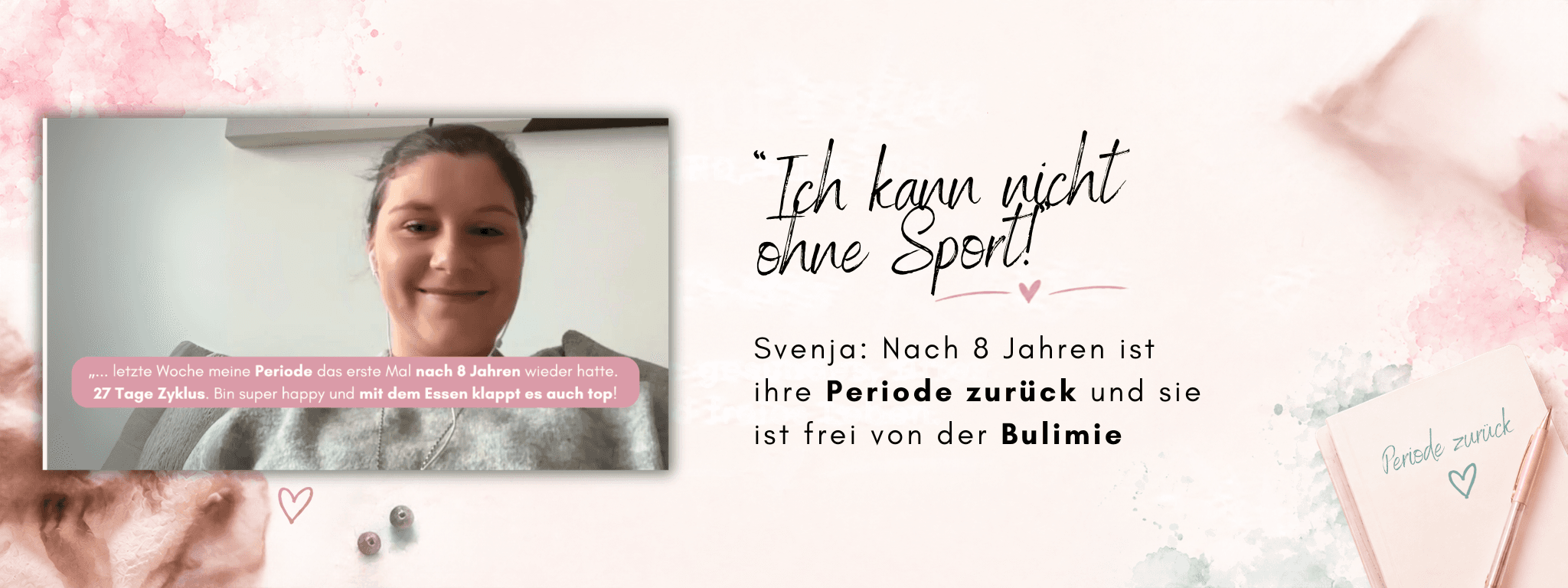
Dear Lina, just wanted to write and tell you the great news: last week I had my period for the first time in 8 years. A 27-day cycle. I’m super happy, and things are going great with food too!
Svenja
When this message lit up on my phone, I had to read it twice. Eight years without a period, ten years of food problems, first anorexia, then bulimia, plus compulsive exercise that almost cost her the sport she loves so much.
Svenja lives in Berlin and works in film. She was already in therapy at 16, and several coaching programmes followed later. At the beginning of 2024 she started 1:1 coaching with me, with one clear wish: freedom, a life in which food can simply be food.
How it’s possible to get your period back after bulimia and years of compulsive exercise is something Svenja tells you herself in this article.
I’m Lina, a state-certified nutrition consultant and health coach for women’s health. I know this pattern not only from working with clients, but from my own story.
Svenja’s path at a glance
At 16
First kilos
Ill, lost weight, praised
At 16
Plan and scale
Stable, yet a stranger
After that
Bulimia
Robot mode, compulsive exercise
Early 2024
Starting with Lina
Blood work, food, mind
Injured
Injury
Healing over the scale
After 8 years
Period back
27-day cycle
Today
Joyful exercise
Pizza and carbs
What to expect
“A few kilos less for the summer”
Svenja’s beginning was almost classic: at 16 she was ill, lost weight and suddenly got attention for it.
Then it was spring, and I thought, for the summer a few kilos less would be nice. Then we had a family holiday in autumn, and I thought, lose a bit more for that. And at some point it just keeps getting less, and you really lose control over it.
Svenja
Puberty came on top. Her body changed without her having any influence on it, and losing weight became an attempt to take back control. Svenja always knew she had a problem. But admitting that she couldn’t find her way out alone took a long time for a perfectionist like her.
I come across this pattern often: change is frightening, and body and eating seem to be the two areas you can still steer. The eating disorder then works like a railing on a shaky bridge, until you notice that you’re not holding on, you’re being held: by apps, numbers and an ideal.
Svenja was lucky to have her mum by her side, who had had eating disorders herself and saw through her tactics and excuses early on. For her mum it was like looking in a mirror, and yet she remained a reliable support. Just as important were friends who didn’t look away.
Are there people in your life who are allowed to look, or are you holding everything together on your own right now?
Stable in weight, unstable in self-worth
At 16 Svenja started behavioural therapy, in which weight gain and weekly weighing were the focus. She still understands the approach today, and yet she describes that time like this:
After a year my weight was stable, but I was so far away from myself. I had never felt so alien to myself. I just functioned, I got a plan of what to eat, but I never once asked myself: do I actually feel like that?
Svenja
After that she oriented herself by plans and by people on TikTok with similar stories, and adopted whatever seemed to work for others. Her own signals went unheard: “Actually I’m tired and should rest, but my head said I still have to do this and this today.”
At some point she felt like a computer that only functions. Food became the only way out of this robot mode, a moment in which she didn’t have to think. That developed into bulimia.
I know this cycle well: exhausted and empty in the evening, the emptiness is filled with food, followed by guilt, compensation and the next diet. A meal plan alone can’t break it, because it doesn’t touch the need behind it: the wish for a break from your own head, for a hug from the inside.
Free Hormone Signal Check
Find out within 5 minutes which of the 3 hormone traps you are currently stuck in.
Exercise: from punishment to joy
For Svenja exercise is far more than burning calories. She has been sporty since she was five, played nine years of squad basketball and has been running for over ten years. Many of her friendships began through sport.
In recovery a complete exercise stop is often recommended. I never asked that of Svenja, and looking back she says:
It already took so much strength to step out of my comfort zone with food and give my body more again. If I had taken away exercise as well, I would have been completely lost.
Svenja
I used to exercise to earn my food. Now I eat so I can exercise.
That’s exactly the decisive point: It isn’t the exercise itself that’s the problem, it’s the energy deficit. Professionally this is called relative energy deficiency in sport (RED-S): if the body permanently gets less energy than training and everyday life use, it shuts down functions that aren’t immediately vital, including the cycle. If you eat enough and are well nourished, you can exercise during period recovery too. You’ll find more in the article Period missing because of exercise.
Svenja realised something along the way that she wouldn’t have thought possible before: “We women always get put in this box, as if we only eat lettuce leaves. We can eat so much more than we think.” Carbs are her best friend today.
The turning point: injured and still well nourished
Last year Svenja was badly injured twice in quick succession. The cause was reduced bone density. Oestrogen protects the bones, and when energy, nutrients and hormones are missing for years, bone loses substance, often unnoticed until it gives way.
There I had the consequences in black and white. But on the other hand I’m still so young, I can still change so much. And suddenly everything was in the foreground except the question of whether I would gain weight.
Svenja
For five to six months she couldn’t run and paid very deliberate attention to her nutrient supply during that time. In the past she would have eaten even less in such a phase to make up for the missing exercise. This time her focus was on healing, so that she could run with her friends again.
It wasn’t easy, and Svenja talks about it openly: it takes strength to accept that clothes get tighter and the body changes, especially now that the hormones are returning. “But my goal is no longer to be as small and inconspicuous as possible. I want energy, I want strength, I want to keep my period.”
You recognise yourself in Svenja’s story and don’t want to go through this alone any longer? In the free Cycle Clarity Call we’ll look at where you are right now, together.
To the free Cycle Clarity CallWhat was different this time
Before working with me, Svenja had already done several coaching programmes, with lots of input, exercises and techniques. Her conclusion:
You know a lot. But you have that voice in your head, those routines, and even though you know it’s not good for you, you don’t know how else to help yourself. I had to understand how my body works and how it communicates with me.
Svenja
What had been missing until then was the holistic view. We analysed her blood work and found values we could work on, even though she had been told before that everything was fine. We didn’t look at her nutrition with the question of what she was doing wrong, but what she could add, and we explored where her behaviour patterns actually came from.
Today friends come to her with their blood results. That is exactly the aim of coaching: a stable foundation so that you aren’t dependent afterwards, but continue your path with your own tools.
What Svenja does differently today
Going out for pizza spontaneously, without “saving up” earlier in the day.
Going to birthday parties without thinking beforehand about what food there will be.
Drinking a Coke with sugar. She used to not even trust a glass of Coke Zero someone put in front of her.
Exercise out of joy instead of as punishment, with enough food before and after.
Recognising old patterns, reflecting on the day in the evening and forgiving herself.
How often have you said no to friends because you were afraid of what would happen around food?
“Your gravestone will never say: she always said no to pizza”
Svenja once picked up this line somewhere, and it stayed with her. In the end nobody will remember what dress size she wore. But she herself remembers the many times she said no out of fear: to pizza, to dinner with friends, to spontaneous plans.
At first she hoped the topic would be settled for good in six months or three years. Today she sees it differently: it remains part of her story, but not a threatening one, rather the chance to get to know herself and her body again and again.
Your body is not your enemy, it’s your friend.
For a long time Svenja was the listener who thought everyone else was much further along. Today she knows: Anyone who engages with this topic and gets help is already a step ahead of many. As soon as you are suffering, you deserve support, no matter whether another woman’s story sounds “worse”.
Dear Svenja, thank you for your courage and your openness. I’m incredibly proud of you. How she is doing almost a year later, she tells in episode 104 about her life after bulimia (in German).
🎧 Prefer to listen? Here’s the full episode (in German)
Would you like to talk with me about your challenges and goals and get your first impulses for your journey?
To the free Cycle Clarity CallHappy, Healthy & Confident into the new week.
Every Monday — insights on cycle, hormones & female health. Straight to your inbox.